

The Arts "a Drain on the Economy"? I think not.
Of course, some drains can be of benefit to the economy. The draining of lands around the Corrib in the 19th century allowed the reclamation of lands for agriculture. Similarly, the vision and hardwork of Druid Theatre Company and the Galway Arts Festival in the late 70’s and early 80’s did much to stimulate the subsequent reclamation of the then moribund area now famous as the city’s Quay Street. I doubt anyone would call the €20m direct benefit generated by the 2010 Galway Arts Festival a drain on the local economy.
A few headlines from the 2011 report prepared by Indecon for the Arts Council: Over €700m in generated in the national economy by the wider arts sector which includes film, publishing, music, theatre and other cultural institutions; this sector also spent €1.5 billion in the wider Irish economy and employed over 20,000 people both directly and indirectly. These figures do not include the other economic benefit of the arts to the tourism and hospitality sector. I don’t see any Galway City publicans or hotel owners complaining about the arts during the Film Fleadh and the Galway Arts Festival. The wider arts sector contributed over €300m in direct and indirect taxes in 2010. If we were to include all the other creative industries such as television, radio and software development linked to the arts sector, the entire creative industry sector is worth €4.7bn to the Irish economy, employing both directly and indirectly almost 80,000 people.
But perhaps from behind his bar counter, Mr O’Grady hasn’t noticed the other drains in the Irish economy at present. For instance, the drain of talented and creative Irish people working in multimedia, film, publishing and theatre in the US and UK because there isn’t the work here. Maybe he hasn't noticed, but the biggest drain on our economy at present would appear to be the bill for the ponzi scheme created by the people running the property and financial markets in the last ten years.
Mr O’Grady, is it that your gombeen light is on - or is it just the blood draining from your face?

Improving background music through 100V horns
The nature and physics of the traditional 100v horn dictates that the musical bandwidth of the horn speaker is limited and although there are better 2-way horn speakers now available which stand up to the challenge of a full-range sounding speaker, budgets dictated otherwise.
So to provide a system more suited to background music in conjunction with the horn speaker system, I incorporated several 100v or "constant voltage" 2 way speakers into the system design. These would be located closer to head height than the horn system, in areas around the market where people congregate such as near Gluehwein, coffee or Hot-Dog stalls.
The speakers we used were older (and yes, quite cheap) 6.5" speakers that had done their time and already provided a good financial return. The speaker terminals were protected to a degree from the elements using a cut-out PVC junction box glued to the cabinet using Sikaflex adhesive/sealant which was a substance I use in repairing the motorhome.
By selecting a low watt tapping, we were able to integrate them into the horns located nearby. The horns provide the mid cut or "bark" with the 2 way speakers adding bass and some treble fizz. Now it's not hi-fi by any means but the combination is certainly easier to listen to than horn speakers alone.
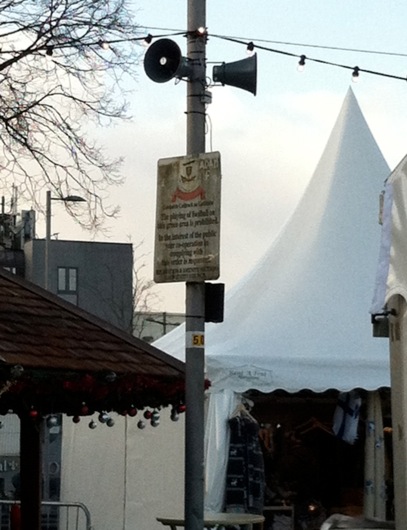
6.5" 2 way 100v speaker rigged below a pair of traditional 100v horns. The 6.5" speakers aren't hi-fi but make background music at this Christmas Market sound a bit better around hot-dog and mulled-wine stands.
Audio Solutions: Support Bands
1. Type out a channel list and draw a stage plan with power and monitor requirements. Word and Excel are fine for this. Try and keep it all on one page. Now send it to the promoter, the band you are supporting and the house sound crew or the PA provider.
2. Be on time. That means too early.
3. Think about providing some of the following items to make the sound crew's life easier. They will like you for this and may be inclined to go that little bit further to make sure your set goes well.
- Latin Percussion Mic Claws for the Kick, snare top and maybe also for your under-mic-ed hats and under-mic-ed overheads with some Sennheiser 604's or Shure B98s for your toms. Less mic stands means less stuff to move on and off stage. This means that when you build your kit off-stage, it's mic'ed and ready to be plugged up onstage. Even better, also provide a working, labelled pre-made mic loom for the drum kit. A sound crew will love you for this.
- Z mic bars or the Audix CabGrabber for your combos. Again less mic stands to be schlepped onstage.
- If you use a lot of DI's for a keyboard or hard-disc set-up consider bringing a rack-mounted DI rack with some XLR cable pre-loomed and labelled. There are some reasonable quality units that don't cost the earth. They may not sound the absolute greatest, but the goal here is to get as much time onstage as you can. Better still, get a small sub-mixer to mix your multiple synth channels down to 2 channels
4. Try and have your gear in a manner that facilitates easy movement. That means the combos should be on wheels and keyboard/midi/laptop setups should be easily pre-wired offstage ready to power up and connect once you are onstage.
We've put together some packages that combine some or all of the above items. If you are interested in discussing your requirements, feel free to get in touch.
More Than Just PA Hire
Outside of my work with Alex Fernie Audio Ltd., I've done a lot of consultancy in a technical management role for events requiring the integration of the various technical aspects to a production. The Irish National Lottery sponsored Skyfest is one such event requiring the integration of large format PA systems, 100v line horn systems, RF and microwave transmission, large-scale screens and live performance with a fireworks display and the live TV broadcast of a lottery draw. I've also provided stage management services to festival stages, co-ordinating multiple act changeovers whilst ensuring the backstage, performance and viewing areas are safe for artists, crew and audience alike. These are skills I also bring by default when providing a system for a client.
Many professional audio hire companies are now also willing to share the burden of audio production management for festival organisers. Alex Fernie Audio provided systems on a large number of weekend street festivals in 2011 where we not only provided the PA systems for the various outdoor and indoor stages, but also provided and co-ordinated the backline and instrument hire for the client. For the past two years we have provided a similar service to the Kilkenny Arts Festival, taking care of both the PA and the backline/instrument riders for the over 30 acts involved over the ten-day festival.
Some, but not all, professional sound companies in Ireland offer these "added extras" as part of their festival rental packages. So if you are someone who is at the early part of planning for your 2012 events, it may be worth considering what your PA company of choice can bring extra to the table.
Druid Theatre Company Purchase Nexo/Yamaha Touring system
Having being a regular hirer of PS10 and Nexo systems from Alex Fernie Audio Ltd since 2005, it made sense for the company to invest in the new PS10R2. Druid Theatre are currently en route to the US, where "The Cripple of Inishmaan" will tour for the next five months. 2011 promises to be a busy one again for the theatre company, with new productions in the pipeline for the second half of the year.
The combination of the Yamaha LS9-16 with MY16AT card and an Echo Audio AudioFire12 will allow the company to run the sound for shows from a Apple Mac running Qlab Pro via MIDI as they have been doing for the past 2 years. The AudioFire12 is a 12in/12out firewire interface.
The purchase also includes a range of flightcases for amplifiers, consoles, cable and speakers.
Druid have also purchased some EV ZX1's, amplification and microphones for their redeveloped theatre space which, when not in use by Druid, is available to hire for theatre shows, as a rehearsal space or as a venue for press-calls or media receptions.
www.druidtheatre.com
www.nexo-sa.com
www.yamahaproaudio.com
www.echoaudio.com
Planning an Election Campaign?
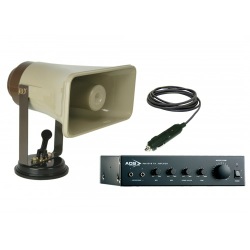
Roof mount horn and amplifier
If it's election time, hustings, advertising this simple system will get your message across. Plug into the cigar lighter of your vehicle and fit he horn loudspeaker to your roof and you have a powerful promotional tool. When you are finished, unplug, remove the roof speaker and your vehicle is back to normal.
Buy for €340 (inc VAT)
Hire for €30 per day (inc VAT) or €120 per week.
Call us on 091 789848.
Ten Reasons Why Roadies would be better than Politicians at Running a Country
There is a common misconception that Sound Roadies can only count to two, however this ignores the fact that they have a mental ledger dedicated to remembering who paid for what at the last petrol station. Tour manager Roadies are good at hotel room numbers and if you were to tell Merchandise Roadies to mind a country’s finances, they would guard them with their life.
Politicians have a tendency to forget and confuse numbers and, when they remember them finally, add extra zeroes at the end.
2. Roadies don’t mind working in the summer. Unlike politicians, roadies will gladly work in July and August. In fact, roadies will work over Christmas also. Another fact; a holiday for a roadie is a late start in a hotel bed. Any longer and it is unemployment.
3. Roadies are always on time. If a Stage Manager Roadie says something will start at this time and finish at that time, it will. With seconds to spare.
4. Unlike a former Irish Taoiseach (Prime Minister), Roadies would never mix up “smoke and mirrors” with “cloak and daggers”. Smoke and mirrors combined can create stunning visual effects and is best left to Lampies. Smoke and daggers combined means a meeting between the props and lighting roadies, which could take days, usually resolved by the Stage Manager Roadie. (see 3 above)
5. Roadies dress better than politicians and have better hair.
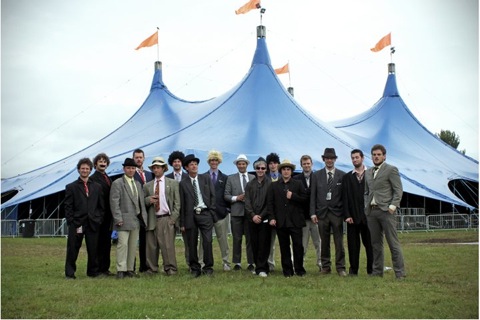
6. Roadies can and will give a straight answer to any question in their particular area of expertise. Even the boring ones, such as “do you do this for a living?” or “do you know the band?” will get a short, straight and perfunctory reply. If they don’t know the answer to a particular question, they will helpfully point you in the direction of the person who knows everything – the truck driver.
7. Unlike a present Irish Taoiseach, Roadies have remarkable and unequalled constitutions that allow them to stay up late discussing the happenings of the day yet be capable of fulfilling their duties the following morning.
8. When a Roadie breaks something (and it does happen occasionally), they will, unlike politicians with an economy, fix it. And they will fix it on time (see point 3 above). If a Roadie breaks something and can’t fix it, they will at least have the decency to make an amusing video about it.
9. Like politicians, Roadies make lots of friends in tents in the Summer. However, unlike politicians that does not mean that they will take their money and make lots of unrealistic promises to their new friends before asking the audience to foot the bill in a few years time.
10. Finally, Roadies are resourceful. For example, watch how Roadies can open a bottle of wine with a shoe.
11. Because only Roadies know there will be one more.
List Hire Prices
Below then is are the list prices for individual items in our inventory. All prices are Ex VAT of 21% and are prices for a one day hire.
For best prices, please call or email and ask for a quotation.
Speakers (Includes stands, rigging and cable as required)
Nexo RS15 €55
Nexo S1210/S1230 €55
Nexo PS10 €25
Nexo LS500 €25
SSE MB4 monitor €15
QSC K10 active speaker (2 mic/line input) €50
Amplifiers
NXAMP 4x4 €45
NXAMP 4x1 €35
Camco Vortex 4 €25
Consoles
Digidesign/Avid Venue SC48 €200.00
Yamaha LS9 16 €80.00
Microphones/DI Boxes (all include cable & stand as necessary)
Shure SM58/SM57 €5.00
Shure Beta 58/Beta 57 €7.50
Shure SM81 €10.00
Shure Beta 52 €7.50
Shure Beta 98 €15
AKG 214 €10
Sennheiser e604 €5
Sennheiser e904 €7.50
Sennheiser e906 €7.50
Sennheiser MD241 €10.00
Neumann KM184 €35.00
BSS AR133 Active DI Box €5.00
EMO Passive DI box €2.50
Wireless Microphone Systems
Sennheiser EW100 G3 with handheld or beltpack transmitter €35
How to stop a projector from moving on a sprung wooden floor.
1 x 55cm square paving slab.
4 x squash balls
4 x rolls of PVC tape
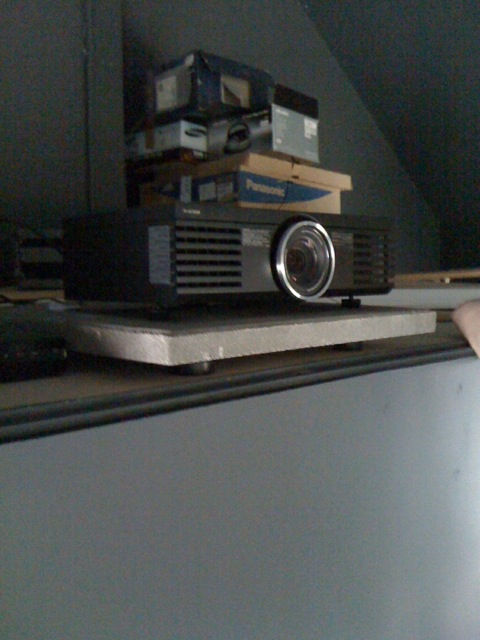
Place the rolls of PVC tape in a square to approximate the size of a the paving slab. Put the squash balls onto the PVC tape roll - this stops the squash balls from moving. Put the paving slab on top and the projector on top of this and adjust to ensure the squash ball/ PVC tape combination is at each corner. Presto! Your projected image is now immune from the movement of the world and will probably survive a minor tremor. We used this to combat a sprung wooden floor in a multi-media exhibition over the summer - worked a treat. Photo courtesy of BC.
Also works spectacularly for record turntables.
Stagecraft: Wiring a stage efficiently, neatly and safely.
Improper wiring of a stage makes for more work when it comes to wrapping up at the end of the night, makes it difficult to trace any faulty cables that may arise during soundcheck or during the gig and can cause trip hazards for artists and crew on- or back-stage. This is the way I was taught years ago and the basic method is the same on every stage right up to the top level.
Before we begin: Upstage = the part of the stage furthest from the audience. Downstage = the part of the stage closest to the audience. Stage left = the side of the stage to your left as you stand onstage and face the audience. Stage Right = the side of the stage to your right as you stand onstage and face the audience.
Mains cable
Heavy mains cable such as 3-phase feeder cable should always be kept off-stage. Excess mains cable should never be left tightly coiled but left in a neat figure of eight pattern under the stage if possible but certainly out of the way of walkways.
When running lighter gauge cable from the mains distro to amplifier racks, use the shortest length possible to avoid having large coils of excess cable in areas where monitor engineers, guitar technicians and other stage-hands are likely to be working. Leave short lengths of surplus cable under amp racks or in the dead space often found behind the amplfier racks. Try and ensure that all mains cable to amplifiers follows a similar path, to avoid tangles during load out. Makes sure it looks neat, if it doesn’t, you probably should redo it.
When running electrical cables to on-stage power drops, best practise is to have at least an upstage and a downstage feed. Try and run mains cable upstage on the drum-riser, following other cable runs for monitors and signal cables if possible. The upstage line will feed mainly guitar and bass amps (backline). The downstage power feed should be downstage of the monitors, and again should follow monitor and signal cable runs. This feed will generally be required to power guitarist’s tuners & pedal-boards and keyboards.
Again avoid using cables that are too long. Tuck any excess cable under on-stage risers or off-stage where possible. That way, if you need to move the powerdrop, extra cable is reasonably accessible. The key is to never cross the performance area (ie the space between the drum-kit and the monitor line) with cable.
Speaker Cable
Similar commonsense applies to running speaker cable. For onstage monitors, follow the same line as the other cable. Use the shortest lengths required, keep excess offstage, and never leave coils of cable onstage beside monitors. It just looks bad. If possible use speaker cable looms with breakout boxes for groups of monitor mixes close together. This speeds up both the load-in and the load out.
Signal Cable
Line systems (multi’s, “snakes” etc) should be preferably flown from stage to the front of house mix position where possible. Other solutions include rubber-mats, cable ramps or creating an audience free zone in the centre of the auditorium. Many venue’s have cable-ducts designed to quickly run line-systems and other control cable to front of house. Modern Ethernet, fiber and lightpipe solutions have greatly simplified this part of cable management.
Onstage, the keys to quick, tidy and accurate signal cable patching are sub-stage boxes and a bit of planning. If you’ve a stage plan, identify where the main cabling areas are going to be. Drum-kits will generally take at least 8 channels, with a couple of channels for the nearby bass rig and two vocals, you’re looking at a minimum of 12 lines pretty close to each other. Rather than running 12 long cables over and back to the main stagebox, drop a 12way substage box infront of the kit and run twelve short cables to the mics and DI’s required. It’s simple maths: it’s far quicker to wrap up 15m stage box and 12 3m cables, a total of 51m of cable, than wrapping up 12 10 metre cables, 120 metres.
Other areas possibly requiring stage boxes are keyboard-land and the front line of vocals with acoustic guitars and so on. Label stage boxes with the main input number and what this channel is for (centre vocal, snare, kick, whatever). Again, same rules for running cable apply: follow the other cabling routes, use shortest cable necessary and never cross the performance area or stage-access routes. Finally, leave any excess neatly coiled under mic stands. Always keep excess as close to the source – this makes it easy to move a mic later on.
Always start by running your mic cable from the main stage box or the substage box. There’s two good reasons for this: (1) it means the excess will always be by the mic and, (2) if you are working in a team, there is no chance of one of you accidentally plugging in the wrong mic into the wrong channel. Lastly, keep a few cables handy onstage as replacements if needed. Don’t close the cable box and stash it in some hard-to-access place.
Conclusion
Remember the old saying: the load out begins at the load in. By using some commonsense, you will have more time to make sound, tune the system and troubleshoot any problems arising by followin these groundrules. Your stages will be safer, your cables will last longer and you will make less mistakes. Finally, you will be heading home from the gig a lot earlier.
Summer Round-up
The month of May saw the Inishbofin Arts Festival with a great performance from Mick Flannery. Later that month was the first Festival of the Valleys in Clare. There were a lot of flaws with the organisation of this festival in its first year, but under new management it has promise as an annual event.
June was the Galway Powerboat Festival which lasted for a week. Also on the bank holiday was the Little Havana Festival around the streets of Galway. We were also the audio contractor for the Special Olympics opening in Thomond Park which featured the Cranberries. Litton Lane Audio in Dublin were contracted by us to supply a 24 box Meyer Milo system for the event with Yamaha control at FOH and Monitors.
July was the Film Fleadh in Galway, which required a number of Nexo PS systems as well as featuring a gig by Alabama 3 for the wrap party. Then it was into the Galway Arts Festival. This was our 10th consecutive year working on the festival and there were great shows in our venues from Neil Hannon & Teenage Fanclub. We also supplied the PA for the Hofesh Schechter dance show which was an outstanding success.
Into August and having courted them for a number of years, this year we tendered successfully for the Kilkenny Arts Festival. There were some great world music gigs, the Tindersticks played a great show in what is now my favourite non-venue venue in Ireland - St Canice’s Cathedral, Kilkenny. We all had a fabulous time in a great city and look forward to doing it again sometime.
Currently, we’re doing a few shows for the Tuam Arts Festival, which is a pleasant, if low key, end to the Summer 2010. As we speak, Druid Theatre are preparing to premiere their production of O’Casey’s “The Silver Tassie” in Galway’s Town Hall Theatre. The show will tour the UK and Ireland over the next few months and is touring, for an Irish production, a comparatively large PA system from us. The touring package includes Nexo S1210s, S1230s, NXAMPs and a Yamaha LS9 for control.
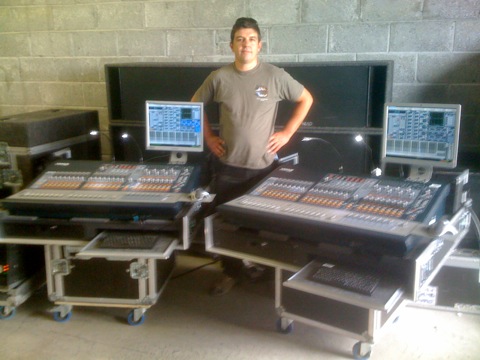
On the inventory side, we rented in a second Venue SC48 for the summer. I’m presently trying to evaluate if we should make the acquistion permanent, however it is difficult to predict how the winter will pan out. Early signs are promising it must be said.
Other smaller acquisitions were additions to microphone stock: KM184s, Shure Beta 98s, Sennheiser 904s, 906s were the main ones. We also added some rigging hardware to offer more options for flying Nexo S12 systems as horizontal arrays.
For those of you using analysis software, I’m finding Spectrafoo a useful addition to the traditional method (ie using your ears). We’ve successfully implemented it as part of our larger PA system setups and, in conjunction with Nexo’s new NS-1 prediction/array design software make implementing multi cabinet PA systems quicker and more accurate.
Finally, we had some Nexo PS10-R2s on sub-hire over the summer. I really liked them and they are certainly a step up from the older PS10.
One other thing, we’re at full capacity with our Sound Support Scheme for the rest of this year. I’ll be releasing details for 2011 in October, and also tweaking the schemes to maintain their appeal for venue owners and gigging bands.
I’ll be disappearing on annual leave over the next few weeks. Thanks to all the engineers, crew, van & truck drivers that worked for us over the summer. Thanks also to our customers, old and new that made Summer 2010 a successful festival season.
Into the Autumn,
Alex.
Venue SC48, Wireless control, Spectrafoo
So loaded the Ecx software onto the console and onto my mac. This allows control via ethernet or wirelessly via a router. All worked first time. For the fun, I downloaded Mocha lite for the i-Phone and was able to view and edit certain setting within the limits of the app. The full version of Mocha gives you a virtual mouse control which is needed to have control over EQ and faders.
20 years of gigs can’t do your hearing any favours and worst is you don’t know if what you are hearing is real or imagined. So I’m biting the bullet and have purchased a copy of spectrafoo. I would love to have the new Smaart 7 but at the level we’re at, the functions available on Spectrafoo standard are standard. I’m presently using the Audix TR40A as the measurement mic.
The great thing about the SC48 is its firewire interface allows you to route the measurement mic and master returns to Spectrafoo via firewire, which saves having to have an extra unit in the rack for FFT duties. Still getting to grips with it so more later.
Please post or tweet with any tips or suggestions
Technical Riders for Newbie Promoters: Part II
The Technical Rider Continued: Backline, Stage, Risers,
Lighting & Crew
In part I of this series, I discussed elements of a standard sound technical rider. This part deals with the rest of the technical rider.
“Backline” concerns itself with the instruments and amplification of the band. Req uirements for DJs operating in a band environment may also be found here. Most often, bands will carry their own backline. However certain circumstances, such as airline restrictions and schedules, may mean that heavier and bulkier items may need to be supplied by the promoter. Drumkits, keyboards and amplification will be listed in order of preference. Finally, keyboard and guitar stands, drum thrones and other hardware will be listed. Touring bands from the US will often need 220-120v transformers onstage for their own equipment as well as American style 3 pin “edison’ adaptors. European acts may look for “schuko” style 2 pin outlets for the same reason. Reputable backline suppliers will be able to provide anything but the strangest request. Many PA companies will also provide backline as part of their service and will be able to offer PA and backline packages.
Before booking an act for your festival or venue, perhaps the first thing to check is that the band will fit on your stage. A well-written rider will have a minimum stage size specified. Just because a certain 5 piece band fits on your stage, it doesn’t mean that every 5 piece band will. Measuring a stage can be done by anyone and costs nothing but your time. Cramped stages have certain knock on effects. If the singer has to stand right in front of the drumkit, he will need more of his own vocal in his monitors. So the singers monitors are louder, all of a sudden the guitarist can’t hear his guitar amp or his backing vocal in his monitors…well you can guess where this is heading. Ultimately cramped stages end up being louder stages, which ultimately affect the front of house sound which your customers are paying to hear.
Most acts will look for low-level stage sections (risers) for drummers, keyboard or brass sections. Cramped stages often mean that risers can’t be used – so the drummer ends up hidden behind the front line singers and guitarists.
If your stage is too small, enquire about hiring extra stage sections. Again, your local production company will be able to help. If your venue is too small to accommodate the minimum stage size requested by the act, then you better get emailing quickly. DON’T ASSUME THE BAND’S CREW WILL WORK IT OUT ON THE DAY. Generally, if you are upfront with a band on any aspect of a rider, they will come to an agreement or be able to work something out in advance of the show.
As I mentioned in part one, touring theatre shows will have an in depth specification of the lighting fixtures required and will forward on a detailed plan of where they are to be hung in advance of the company’s arrival. Lighting for a theatre show is an integral part of the performance and should be treated as importantly as booking flights and accommodation. Lighting riders for bands are generally less specific and many promoters make the mistake of trying to save money by offering minimal lighting. Effective lighting brings atmosphere and excitement to an act’s performance and will add to the audience’s enjoyment. If you want bands and audiences to return to your venue again, make an effort to contact your local professional lighting company to discuss the bands requirements with them.
Unless you are a qualified professional, DO NOT EVER attempt to hire some lights and hang them yourself over the stage or audience area in order to save money.
Finally, a band may require two or more people as crew to help un-load and load their van. Don’t EVER assume that because you have hired a sound guy and a lighting guy that they will do this. They will have enough to do. If a band requires two people, PAY these two people otherwise they will either not show up for the load out, or they will be drunk at the load out, or they may not show up at all. Nothing makes a roadie cranky like the local crew not showing up sober and on time.
NEXT: More stuff on riders for newbie promoters. How the professionals deal with riders. Why heeding the rider makes business sense for a promoter.
Why a Rider isn't a "wishlist": Part I
It can generally be divided into two sections; a hospitality rider and a technical rider. The hospitality rider deals with accommodation, dressing rooms, food, beverages and security and contain items that are easily organised by most people in a hotel. The technical rider is, to non-production types, often a bewildering array of technical shorthand, model numbers and jargon. If you do not understand a technical rider, don’t sign it until you have consulted with a professional production person.
The quickest way to interpret a technical rider is to pass it on to some reputable sound and lighting companies in your area and ask them to price it – remember, unless you are sure your venue can accommodate the technical rider you will have to pay for any extra equipment. But just so that you have some idea what it’s all about, here’s a quick 101 on artist technical riders.
For music acts, the sound system forms the bulk of the technical rider. Touring theatre companies will concentrate more on the lighting side and will provide a lighting plan which will need to be accommodated by your venue.
The FOH or Front of House system is the sound reinforcement system that the audience will hear. Professional engineers will look for reputable, relatively modern brands and designs that they are familiar with and also that there is enough “rig for the gig”. They will most often give a list of suitable systems and need enough of it to provide consistent sound throughout a venue. Professional sound engineers will never simply state that they need “a 4kW PA” or something similar.
The FOH console is the mixing desk. The engineer/artist will want one that can accommodate all the individual channels from the stage and again, one that is a reputable, modern design. Most professional sound engineers no longer have a problem with using a digital board – some prefer them to analogue mixing desks. Again a list of acceptable digital boards will be listed. If an engineer explicitly states that she does not want a digital board, then suitable analogue boards will be listed. Do not assume that just because an act only needs 16 channels they are just being smart by asking for a 32 channel desk. Analogue boards will require a certain amount of outboard equipment; again suitable makes and models will be listed. Makes and models not wanted will be explicitly listed.
The MONS or Monitor System deals with the speaker system the artist hears onstage and as such is in some ways more important than the FOH system. Do not try to skimp on the monitor system. Similar to the FOH system (see - you’re learning the jargon!), reputable, modern brands and designs will be preferred and listed. Monitor systems for bands will need to provide high sound pressure levels, and often detailed monitor speaker design and processing will be given. For larger venues and acts, an analogue or digital Monitor Console and outboard will be requested in a similar fashion to the FOH console.
Generally these specifications are followed by a stage plan and a channel list. The channel list will detail what microphones and other equipment is needed such as short or tall mic stands. The stage plan will show where everything goes and will help your venue or house sound engineer get everything ready in advance of the band arriving. The stage plan will also detail where power is needed on the stage.
Finally, you may see some makes and models of equipment listed on the rider as UNACCEPTABLE. There is generally a good reason for this. Maybe they break down a lot. Maybe they just sound bad to a trained ear. Maybe they are simply useless products. NEVER ASSUME THAT A PROFESSIONAL ENGINEER OR ARTIST IS SIMPLY BEING AWKWARD, STUCK UP OR IGNORANT. If in any doubt, get a professional opinion.
Just like you, the band and their technical crew want the audience to enjoy the show so that no-one dies, we all get paid and we all go home. So remember a technical rider is just that, it’s not a wishlist but it is a list of necessary and minimum items required to do the job.
NEXT: The Backline and Lighting Rider.
AND AFTER THAT: How professionals deal with riders and advancing a show
Subwoofer arrays, new Nexo RS18 and a letter to Mr. Band Sound Engineer.
Speaking of subs, Nexo are demoing their new RS18 sub in Frankfurt next week. More info here. Will miss it unfortunately due to the work commitments here
Oh yeah and while I think of it:
Mr band sound engineer, next time you want an extra 3db across your mains and I’m supplying the PA, just ask - I generally oblige. Don’t say all’s cool and you’re happy and then do it on the sly just before your set. Password protection will be making a comeback....
Why you should use a professional audio company
Correct Advice
Contrary to popular belief, not all sound companies want to hire you equipment you don’t require for your event. Most sound companies will make an effort to discuss your event with you in advance. They will design a sound system based on the size of the room, its audience capacity and the type of performance or event. For larger events, sound companies use highly specialised software in order to accurately predict the sound pressure levels in all areas of a venue.
The loudspeaker system a professional sound company will recommend for your event will give approximately the same audio experience to all members of the audience, no matter where they are positioned in the room. Modern loudspeakers are highly directional, meaning that they can be positioned to minimise acoustic reflections from walls. Loudspeakers are arrayed in such a way that there is a minimal difference in loudness between the front seats of an audience and the seats at the back.
Having a sufficiently large PA system also means that the risk of feedback during your event is minimal. Feedback, and its distinctive the high-pitched whine, most often occurs where a sound engineer is trying to extract maximum level from an insufficiently powerful PA system.
Professional sound companies will also be able to recommend suitable wired and wireless microphones for different applications. Finally, they will be able to advise you on the smooth running of your event in terms of smooth changeovers between different acts and speakers.
The best thing about professional audio companies is that they will willingly give you all this advice for free.
Modern and Sophisicated Sound Equipment
Professional audio equipment has come a long way in the past ten years. Major developments have taken place in loudspeaker and amplifier design. The continuing evolution of digital equipment and digital mixing offer enhanced sound quality for modern event audio.
All professional audio companies have invested to some degree in this new technology which not only gives a superior audio experience to the listener, but also translates into savings on manpower and transport by being better, lighter and more compact than older audio equipment.
To give one example, a modern 48 channel digital console like the Digidesign Venue SC48 offers the same audio control in a package one-quarter the size of a comparable analogue console and processing package from only 5 years ago. The same is true of modern loudspeaker array systems and amplifiers from companies like Nexo, d&b, EV, l’Acoustics and Meyer.
Modern audio equipment is safer. Professional sound companies spend a lot of time and money ensuring that their equipment doesn’t fail on their events. Equipment is regularly tested for electrical safety and rigging equipment is thoroughly overhauled at least twice a year. If equipment should fail during an event, spares will be to hand allowing the event to continue.
Modern audio equipment and systems are more reliable – professional wireless microphone systems from Sennheiser and Shure rarely fail or drop signal these days. Modern audio equipment is more environmentally friendly – it uses less power and costs less to transport. All this makes modern sound companies more efficient and professional in delivering an excellent cost effective service.
Experienced and Qualified Professional Sound Engineers
Professional sound companies value and look after their staff and freelance engineers equally. Even the best sound system can deliver poor results if poorly deployed and operated. So sound companies spend a great deal of time and money ensuring that all employees and freelance staff are fully up to date on their audio systems, health and safety and manual handling procedures.
A full day’s work for a typical sound engineer can often be up to 12 hours. Professional sound companies ensure that their engineers and crews are well paid for work which involves substantial heavy lifting and long periods of intense concentration in noisy and often uncomfortable surroundings. Professional sound companies will schedule breaks and rotate engineers on longer events. Beware of operations that offer “engineers” at minimum wage levels.
Qualified and experienced sound engineers not only ensure the success of an event but also ensure the safety and well-being of audience members and performers alike. Properly laid and dressed cables on stage and throughout the venue are not just neater looking but they also mean that attention has been paid to their safety. Professional sound engineers are aware of the risks posed by excessive exposure to extreme sound pressure levels and will operate sound systems accordingly.
Professional sound companies will be able to produce a health and safety statement and risk assesment checklist on demand for your event. All staff will be fully aware of procedures in the event of a cause for public concern. Professional sound companies carry full public liability insurance and will gladly produce insurance schedules if asked.
And Finally….
Professional audio is a professional business run by professional people. To do it correctly and to maintain the level of investment needed to be successful, it needs to be a 24/365 service. Whilst many part-time or hobby operations can deliver sound, in order to do it consistently well and to meet the needs of artists, performers and the expectations of modern audiences it has to be run as a professional full-time operation by passionate and professional people.
All of us in the professional audio industry look forward to you call.
Using High-Pass Filters
Smaart 7 Preview and Amplifier Size.
I’m expecting our copy of Smaart 7 to arrive shortly. The new version is a significant improvement on v6. Also Smaart is back in the hands of Rational Acoustics - its original creators.
Website, New Products, Audio tips
I’m very excited by the Induction loop kits from Signet, they are easily installed, affordable and offer a solution for businesses and organisations looking to facilitate hearing aid users.
There are an estimated 58000 people in Ireland with a hearing disability - can you afford not to be able to communicate with them?
I’ve just finished giving the website a bit of a sheen for the New Year, a few new photos here and there and some extra information on our product range also.
As a bit of a taster, there was a good article in Live Sound International in December 2009 on Gain Structure which you can download and read here. A must read if you are starting out in the world of live sound mixing and you would be amazed at the amount of sound engineers I meet in an average year that don’t understand these basic principles, so read up!
Why Corporate Indecision is costing the AV industry.
“Client procrastination, coupled with limited technical knowledge, is hampering corporate av projects to an alarming degree and making any sensible business forecasting nigh on impossible, according to participants at AV's most recent roundtable discussion.”
Read more...
SC48 at work
Venue SC48 & new monitor system
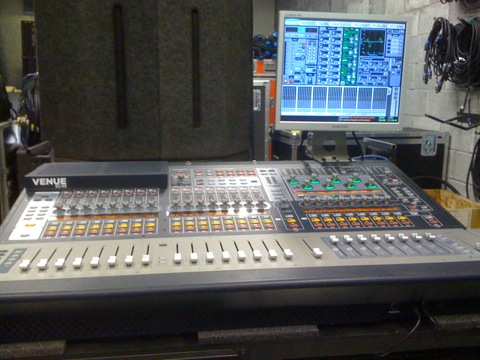
Finally, the last purchase for the next 12 months is a Digidesign Venue SC48. Again having costed, used and listened to virtually every digital board in that size, the SC48 was a no brainer. It’s a full 48 in 16 out console. It’s quick, it’s stable, it’s great fun to use and it integrates seamlessly with the other Venue surfaces. The plug-ins that come with the board are very good and the effects are a serious step up from any other board in its price range.
Added to all this, integrates with Protools LE via firewire offering a virtual soundcheck/record function for 18 fully assignable tracks. First gig tomorrow so more on this soon.
The Future?
Whilst small providers with one small system will always be able to provide budget solutions for small local events, the financial outlay for truly professional systems will keep it a relatively small but highly competitive market. The challenge for regional providers is to be able to match these small operators in price but exceed them enormously in terms of sound quality and service. Small event managers need to be aware of the potential public liability exposure in the event of equipment failure causing injury to artists and audience.
On another note, having said Yes to Lisbon, it’s good to reflect on how the EU has helped the Irish audio industry compete in Europe. The combination of free trade and the Euro has increased the number of potential suppliers available to Irish-based sound companies. Where once Alex Fernie Audio imported most equipment from the UK, now we can add both German and French suppliers to the many UK and Irish suppliers for equipment and consumables. The major challenge facing Irish sound companies at present is competing with the lower labour costs in Northern Ireland and the UK. More on that another time.
As to the website, I’ve added a bit to the media side of things with information on some of the causes we support.
Finally, I’m waiting patiently on an LS9 to add the hire stock. In the short term this will be out constantly with the New De Dannann, but will be available for one off jobs also. More new products are being added throughout October. More on this soon.